How Memorial Sites Can Preserve Stories With a Low-Budget Digital Audio Guide
A military cemetery with rows of headstones but no explanation of who these people were. A memorial park where visitors stand in silence because there is no guide available. A commemoration site where the last witnesses are aging and their testimonies exist only in their memory. Memorial sites carry some of the most important stories a society can tell, but most of them have no way to deliver those stories without a human guide standing next to the visitor.
Why do most memorial sites have no digital interpretation layer?
Most memorial sites operate without any digital interpretation because they assume it requires building a dedicated app, a process that costs hundreds of thousands and takes months. As a result, the default experience for visitors is walking past signs and reading names. Smaller sites, military cemeteries, and local monuments often have nothing at all beyond a plaque.
The reality is that a browser-based digital audio guide requires no development budget, no app store approval, and no IT team. A visitor scans a QR code at the entrance and receives the full experience on their personal phone. The barrier that kept memorial sites analog for decades no longer exists.
What does a digital memorial guide include?
A digital memorial guide delivers recorded testimonies, narrated histories, archival photographs, and explanatory text at each station along the memorial route. Visitors listen to personal stories tied to the exact location where events took place, creating a connection that a printed sign cannot achieve. The content supports multiple languages simultaneously, ensuring that every visitor can engage in their own language.
The audio guide format lets visitors approach a station, enter its number, and hear the narration. There is no scoring, no competition, no game mechanics. The experience is structured around remembrance and learning, matching the tone that memorial sites demand.
How do visitors access a memorial guide without downloading an app?
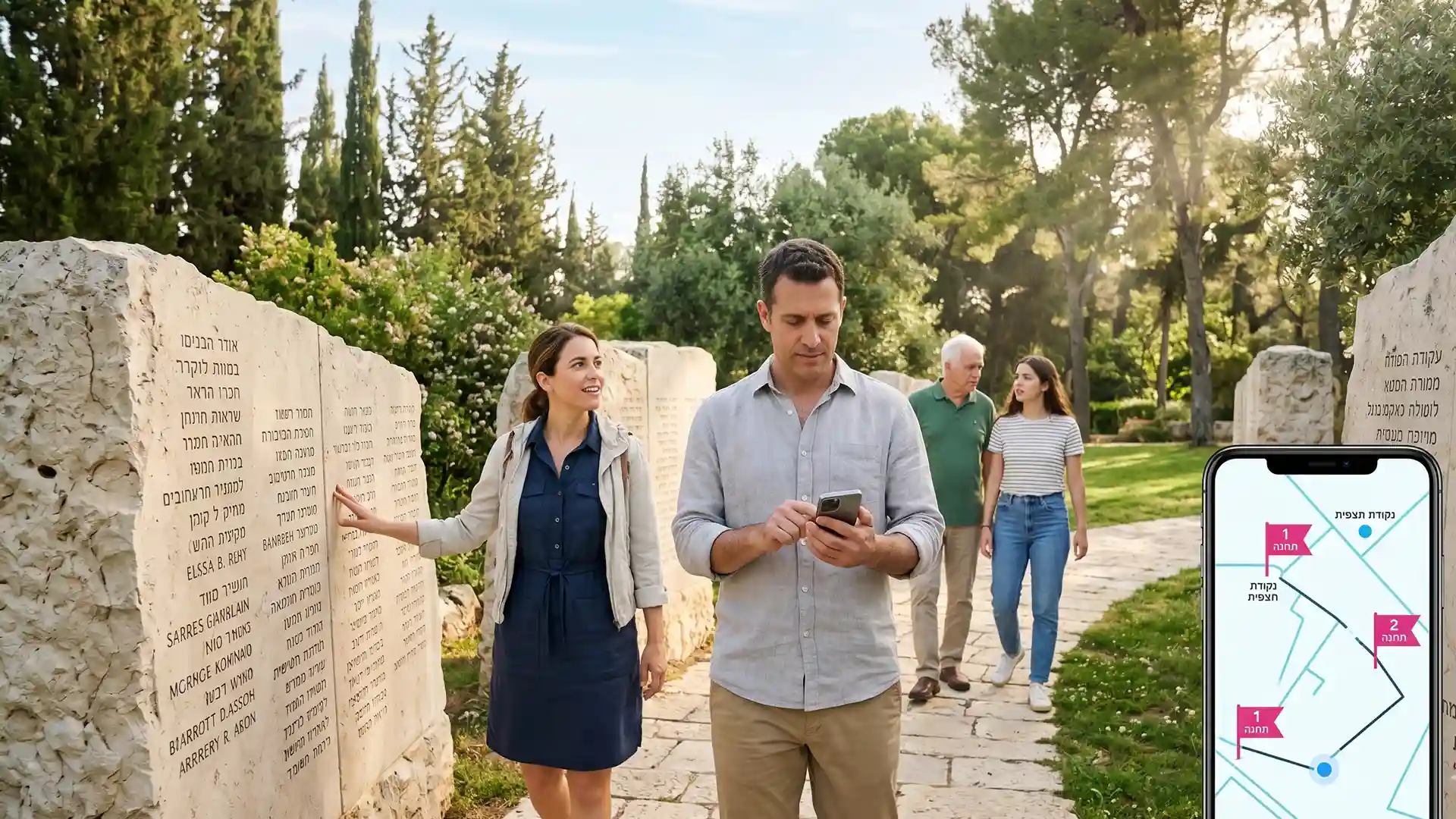
Visitors scan a QR code posted at the site entrance, on a memorial wall, or on printed materials. The guide opens directly in the mobile browser with no download, no login, and no registration. This is especially important at memorial sites where asking visitors to pause and install an app feels inappropriate and creates unnecessary friction during an emotionally significant visit.
The zero-download approach also eliminates hardware costs entirely. There are no devices to purchase, charge, distribute, collect, or sanitize. For sites that operate on limited budgets or rely on volunteers, this removes a major operational burden.
Does a memorial audio guide work at remote sites without cellular coverage?
Yes. The platform pre-loads all audio files, images, and navigation data on the initial scan. From that point, the entire guide runs fully offline. This is critical for memorial sites in remote areas, forest clearings, battlefields, and underground bunkers where cellular reception is weak or nonexistent. Visitor progress syncs automatically when connectivity returns.
Offline GPS navigation ensures that outdoor memorial routes with multiple stations work seamlessly even in areas with no network coverage, keeping the experience uninterrupted throughout the visit.
How can memorial sites preserve testimonies before witnesses are gone?
The most urgent challenge facing memorial sites today is the disappearance of living witnesses. Survivors, veterans, and eyewitnesses who currently guide visitors through these sites will not be available forever. Recording their testimonies and embedding them into a location-aware digital guide ensures that future visitors hear these stories in the exact place where they happened.
A site manager can record audio testimonies, upload archival photographs, and build a complete memorial route in a single working session. The content remains accessible to visitors for years without depending on any individual being physically present.
How long does it take to build a memorial audio guide?
Building a complete memorial audio guide with narrated stations, historical images, multilingual support, and GPS navigation takes one to two hours on the platform. No technical knowledge is required. Content can be updated, expanded, or translated at any time without external help, which means the guide can grow as new testimonies are recorded or new sections of the site are developed.
This speed matters because many memorial sites operate under institutional constraints. Waiting months for a custom app is not realistic when a commemoration event, a school visit season, or an anniversary is approaching.
Comparison: No Guide vs. Physical Audio Devices vs. Browser-Based Guide
| Feature | No Guide (Signs Only) | Physical Audio Handsets | Browser-Based Guide (Spotix) |
|---|---|---|---|
| Visitor Experience | Reading names and dates | Audio narration at numbered stops | Audio, images, text, and GPS navigation |
| Hardware Cost | None | High (devices, charging, maintenance) | None (visitors use their own phone) |
| Language Support | One language per sign | Limited by available recordings | Multiple languages, AI-assisted translation |
| Staffing Requirement | None | Distribution and collection staff | None |
| Works Offline | Yes | Yes | Yes, fully |
| Visitor Data for Funding Reports | None | Basic count only | Full analytics dashboard |
How does a digital guide support school visits to memorial sites?
School groups visit memorial sites as part of formal education programs, but the on-site experience depends almost entirely on the accompanying teacher or an external guide. A digital memorial guide provides a structured learning path that students follow on their own phones, with narrated content at each station that the teacher can review and adapt in advance.
For educational institutions that need to document learning outcomes, the built-in visitor analytics dashboard shows which stations students visited, how long they spent at each one, and whether the full route was completed. This data supports post-visit classroom discussions and satisfies institutional reporting requirements.
Where does a memorial audio guide make the most impact?
The sites that benefit most are the ones that currently offer no interpretation at all: military cemeteries where every headstone has an untold story, local commemoration monuments that mark events the community is starting to forget, battlefields and historical sites where context transforms a field into a meaningful experience, and newly established memorial sites that have not yet developed a visitor infrastructure.
A single digital guide built once can serve every visitor who arrives at the site, in their own language, at their own pace, for years.